Stephen Rayment
Founder, CEO & Group Managing Director
Founder, CEO & Group Managing Director
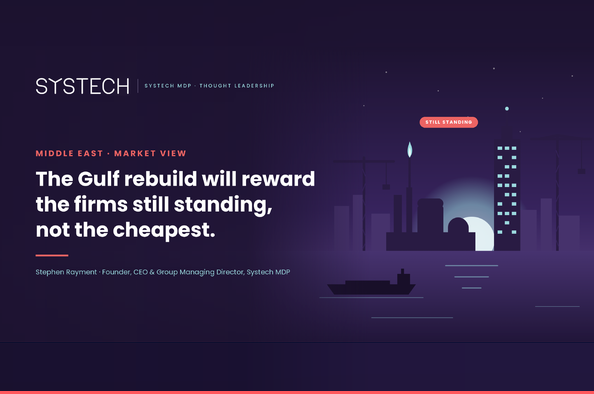
The war has disrupted the Gulf’s growth story, not ended it. When the rebuild comes, it will reward the firms that stayed credible and got paid, not those that cut fees to fill capacity.
The Gulf’s growth story was building. The war has disrupted it, and some plans have been paused or scaled back. I remain positive about the region’s long-term prospects, and I expect a significant rebuild, led by oil and gas, once conditions allow. But the next stretch will test which firms are still standing when it arrives.
The conflict that began on 28 February 2026 has continued to disrupt shipping and trade through the Strait of Hormuz, and conditions remain unsettled. Nobody can say with confidence when normal conditions will return, so I think consultants should plan for a longer period of uncertainty rather than a quick recovery.
According to MEED Projects data reported by AGBI, Gulf-wide monthly contract awards averaged about US$32 billion before the war, dipped to US$17 billion in May and were US$20.5 billion in June. The picture varies by country and sector, and where governments are funding projects, activity has held up better.
Project-dependent advisory work has slowed in some places, but disruption also generates claims. Both the 1999 and 2017 FIDIC editions treat war and hostilities as qualifying events for time relief and, for war, cost relief, and the 2017 edition requires notice within 14 days. Causation and evidence will decide many disputes. A Dubai court has held, in a case arising from the 2023 Sudan conflict, that force majeure cannot excuse a breach that predates the event.
In any period of stress, payment risk rises. Allianz Trade expects the war to push global insolvencies up about 6% in 2026, two percentage points above pre-war expectations, with construction among the sectors most affected. For consultants, that makes it more important to know who is funding a project, and how and when we will be paid.
We are seeing consultancies reducing Middle East headcount or moving roles to Asia, and lower-priced Asian and Indian competitors gaining ground. I can’t point to public data that confirms this yet, so I treat it as a signal to watch. Well-funded firms and investors are positioning for the recovery, and at least one large advisory firm has said publicly that it plans to grow its regional business several times over by taking share from rivals, even though it does not see the market growing.
What I am sure of is where competing on fees leads. Firms that chase work by cutting rates also cut the investment that makes the work worth buying: experienced people, proper review and robust evidence. Clients with tight cash then push prices down further, and the cycle feeds itself. Add elevated payment risk and the economics stop working, because a low fee that is paid late, or not at all, is a loss. That is not sustainable, and I do not intend to take part in it.
THE RACE TO THE BOTTOM
A low fee that is paid late, or not at all, is a loss.
When security allows, I expect substantial investment in rebuilding and strengthening energy and other infrastructure, led by oil and gas. Work on that scale generates contracts, variations, insurance matters and disputes for years, which is exactly where experienced claims and commercial management consultants earn their keep.
The timing is the difficulty. The rebuild depends on security, shipping, funding and access to sites, none of which can be assumed. Meanwhile capital is positioning early. I understand the logic, but growth targets set for a boom do not shrink because demand has stalled. They create pressure to win work at any price to fill capacity, which feeds the race to the bottom. The firms that benefit will be those still solvent, still credible and still paid when it arrives, not those that bankrupted themselves waiting.
STILL STANDING
The firms that benefit will be those still solvent, still credible and still paid when the rebuild arrives.
A credible Middle East capability is not optional for a firm serving global clients. International contractors work across the region and expect their advisers to be on the ground, understand local contracts and law, and mobilise quickly. We will keep that capability in place, sized to current demand and ready to scale when the rebuild gathers pace.
But we will be selective. Systech will support two types of client in the region: our global international contractor clients, and ad hoc employers who accept appropriate payment protections. Those include our right to suspend services for non-payment and a lien over documents and work product until we are paid. This is not a retreat. It is how we stay in the market sustainably while payment risk is elevated, and it lets us keep serving the clients who depend on us.
I remain positive about the region. Governments and investors have long-term plans, and the energy system will be rebuilt. I would stay present, compete on credibility rather than rate, and be disciplined about who we work for and how we are paid. Cutting fees to win work does not build a business, and neither does adding capacity ahead of demand.
What are you seeing on fees, capacity and payment? I’d welcome your views.
Systech is an independent, privately owned consultancy providing claims, dispute resolution, commercial management, legal and expert witness services. This article reflects Gulf market conditions as at October 2026 and is general commentary, not legal or financial advice.